Mark Taylor
7th October 1965 – 17th December 2025
Members in the Eastern Network of The Access Association were recently very shocked to learn of the sad passing of Mark Taylor. Having joined the Association during its very early days, Mark had been Chair of our Eastern group for longer than almost all of us had been a member. He was the driving force behind our group, and very much its heart and soul, and his ‘election’ as Chair had become a happy formality.
I must have known Mark for upwards of 15 years, without actually knowing him. We got on well and I worked closely with Mark in organising the 2016 Access Association AGM and Seminar, when the event was hosted by the Eastern Region, and also helped with day to day communications with Eastern Region members, and with the occasional site visit – but, as typical men, we never talked about our personal life. What I can say, though, is that Mark was always great company. He had a great sense of humour and the ability to recite endless interesting historical facts and anecdotes. He was a big fan of rugby union and football, and I know that he supported Chelsea, but I knew little of Mark as a person.
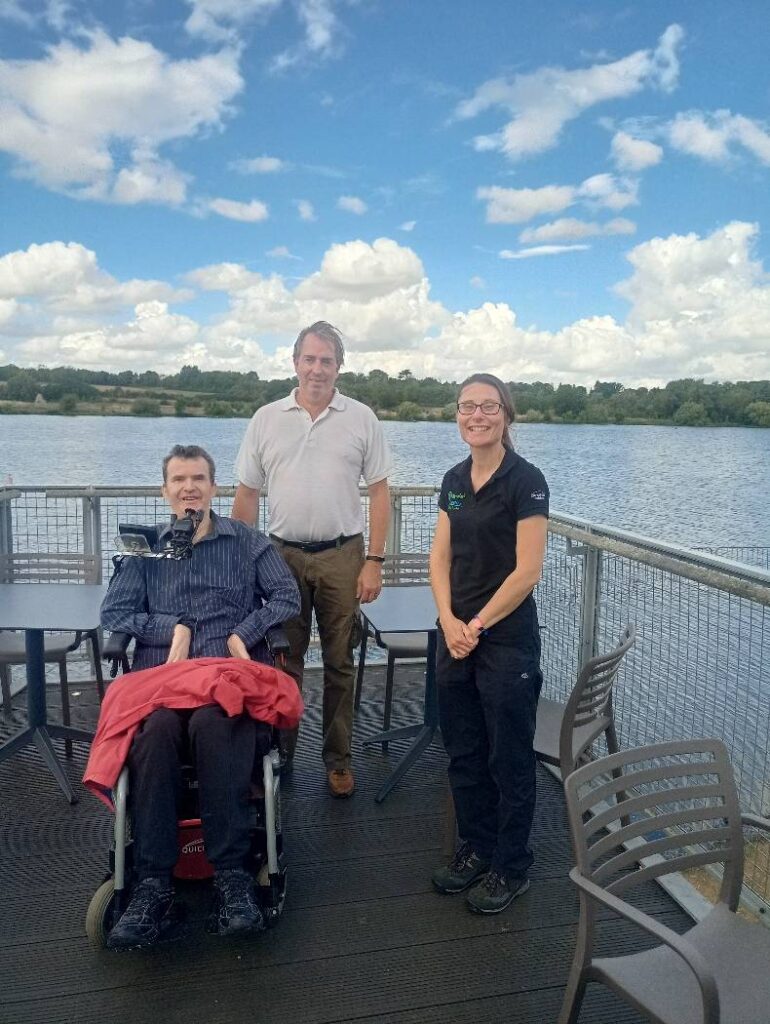
The photo included is the only one I have of Mark. It was taken during an Eastern Region site visit to Ferry Meadows, in Nene Park, Peterborough, in 2022. (That’s me, in the centre, with Mark on my right; on the left is Susan Evans, who had hosted the site visit).
It would appear, then, that I am very poorly qualified to do Mark justice with an obituary, but I did discover, soon after his passing, an article that he himself wrote, for the Disability Heritage website Capturing Cambridge, entitled “Reflections on a Personal Disability History, by Mark Taylor”. As the heading suggests, this is a very personal account of Mark’s lived experience of being a disabled person, but it also contains details of the key events in Mark’s life and his many achievements. For anyone wishing to read the full article, it can be found at: Reflections on a Personal Disability History by Mark Taylor | Capturing Cambridge . The following is an edited version that attempts to provide an account of Mark’s life, in Mark’s own words.
“I went to college in 1985, had my 20th birthday and when playing rugby for the college team managed to have a spinal injury, leaving me paralysed in all my limbs. Within a week, I was in Stoke Mandeville hospital, at the National Spinal Injuries Centre. It had an international reputation for excellence and I had no doubt I would be restored to the ‘normal world’. I met Jimmy Saville, Noel Edmunds, John Entwhistle of The Who, Frank Williams, Norman Tebbit’s Wife, Cheri Gross, the diver who saved Simon Le Bon, a leader of a Hell’s Angel chapter and others. Stoke Mandeville was odd. Everyone was motivated, wheelchair use was almost glamorous (depending on the brand of chair) and local shops and pubs were used to accommodating groups of wheelchair users. Many motivational speakers had spinal injuries, had moved into the area, married a nurse and worked for a disability charity. I didn’t object to marrying a nurse, but I had no wish to live there or work with disabled people before my accident and had no wish to do so now.
Going home was odd. We lived in a run-down Victorian villa that came with my father’s job. [Mark’s father was a chaplain] It had level access and I used my father’s reception room as my bedroom while my old upstairs bedroom became the reception room. However, my local pub had two entrance steps, the rugby club bar had a flight of steps and friends’ homes had steps numbering two to 20. Initially, this was OK as I had plenty of young, strong friends to lift me upstairs. However, I couldn’t go to these places without being in a group and risks were taken carrying me down flights of steps by drunken companions. Fairly soon after my return home, I went down a country road from where I could see the fields I played in as a child. It upset me to think that I could never go to those places ever again.
“Key to my ability to do things was having a wheelchair accessible van that carried me as a passenger – I spent my £16,000 compensation on a converted Ford Escort. Its ramp and high roof made it very obviously a specialist vehicle. No member of my family had ever had a new car and I could have had two Saab sports cars for the same price. I cried the day the car was delivered as it was so obviously a ‘disability vehicle’. However, I had little choice as no buses, trains or taxis were accessible. As I had difficulty with accessing buildings, places and transport, I blamed myself for having been injured, rather than wondering why things had been deliberately designed to be the way they were.
“I had to get used to being patronised, sometimes unintentionally. In one café I went to, the owner made engine noises for me when my wheelchair was moving. In a Spanish restaurant in Britain, the waiter spent the whole evening swearing about me being in the way, in Spanish. My friend, who taught Spanish, thanked him in a very complicated way, revealing that she’d understood him. When applying for a student bank account, the clerk asked my carer for my name.
“I had been studying history at a college in Winchester, where my needs weren’t catered for. I found out that Southampton and Sussex University had the facilities I needed so I went there to study for my BA and Masters degrees. Southampton had a really good, integrated hall of residence. After that, I had the opportunity to undertake post graduate studies at Downing College, Cambridge. I received an award towards my fees from the Snowdon Foundation, a charity supporting disabled people. A new facility, called Bridget’s, opened in Cambridge, which offered accessible accommodation for all 30 of Cambridge’s colleges – none of the colleges had wheelchair accessible rooms. I met The Queen Mother during the official opening of the facility. In those days, I often had to take very odd routes to lectures, using back entrances to libraries, a goods lift to tutorials and inappropriately sloped ramps to seminars.
I later received a Rotary Foundation scholarship to study in Los Angeles. The Americans with Disabilities Act had only recently been enacted in the USA. Watching the news, there, I found it odd that a man was suing his gym because he could only use a side entrance, not the main one. At the time, I thought he should be happy to just have access.
“I finished my academic career by applying to Keele University to undertake a course to enable me to teach in further education. On arriving for my interview, it was clear that they hadn’t read my application. They were unaware that I used a wheelchair, as they had arranged for the interview to take place in an inaccessible room. Afterwards, they wrote to me to say that, due to my disability, I couldn’t be accepted onto the course. My MP and former lecturers challenged this decision and I eventually was given a place on the course. I arrived to be told that I could do the theory, but not the teaching practice. I challenged this and was eventually allowed to do the practice. On the course of 30 students, I was the only person to hold an Oxbridge degree, but, although I applied for many posts, I was unable to secure an interview, while all the others found employment.
“I now felt that I didn’t know what to do. It was a very depressing experience, but after a year I secured a post as a publications officer at Disability Cambridgeshire, producing books, factsheets, newsletters and webpages for the charity. I hadn’t planned to work with disabled people but now I was. During this time, I also supported colleagues on the advice line. From this experience, I realised just how many disabled people had their lives made difficult by the lack of accessible transport, or through being unable to interact with their local community.
“Since 2001, I have been the Access Officer at Cambridge City Council. I take great pleasure in seeing that places are far more accessible now and take particular joy in helping individuals with an access issue. It is good to see that all Cambridge colleges have accessible rooms and that students use the same entrances and lifts as everyone else. Since 1995, every building that has had work done on it has had to meet minimum access standards.
Britain isn’t a perfect place but, on the evidence of some of my travels, I would say it is one of the better places in Europe. Our planning system does try to improve things and the attitude of people towards me is so much better than it was 35 years ago – I don’t remember the last time I was patronised. I think the DDA has done some good and I enjoy the fact that, when I arrive on a site visit for work, the host usually understands the difficulties I have with access.”
A celebration of the life of Mark Taylor was held on the 14th of February 2026 at Castle Street Methodist Church, in Cambridge. The church was packed to capacity with Mark’s friends and relatives. I was very happy, along with Vaila Morrison, to represent The Access Association in saying farewell to Mark.