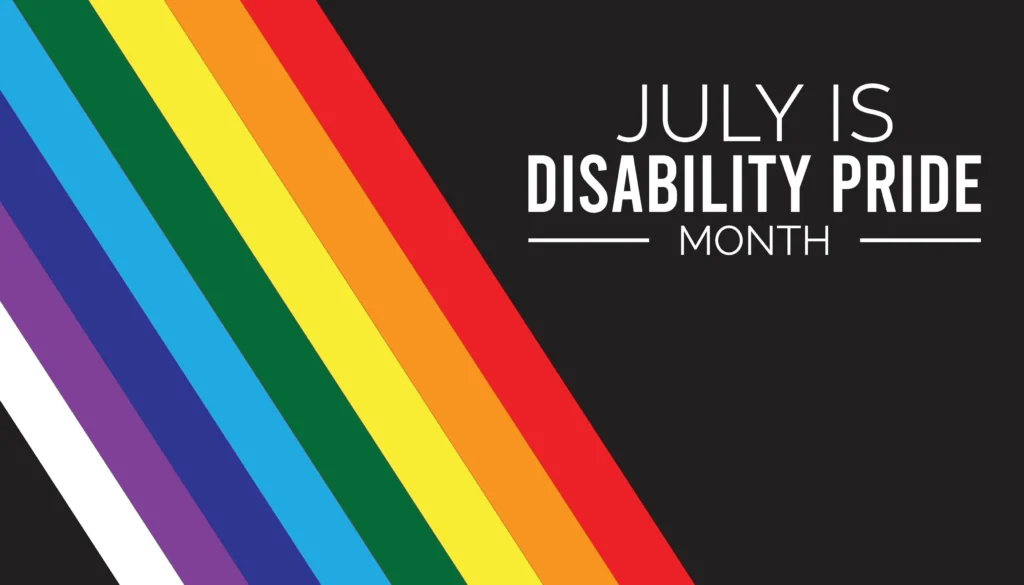
Every July, Disability Pride Month brings disabled people, allies, organisations and communities together to celebrate disability identity, challenge stigma, and push for a more accessible and inclusive society. Disability Pride Month is not only a celebration but a statement: disability is a valued part of human diversity, not something to be hidden, pitied, or fixed.
Disability Pride Month runs from 1st to 31st July each year and is an opportunity for disabled people to share experiences, express pride in who they are, and start conversations that lead to real change.
What Is Disability Pride Month?
Disability Pride Month began in 1990 in the United States of America, marking the passing of the Americans with Disabilities Act (ADA); landmark legislation that protected the civil rights of disabled people. From there, it grew into a global movement. In the UK, Disability Pride Month has been actively celebrated since the mid‑2010s.
The month is rooted in the social model of disability, which recognises that people are disabled by barriers in society – such as inaccessible environments, negative attitudes, and lack of support – rather than by their impairments alone. This perspective shifts the focus from fixing individuals to fixing systems and barriers.
Disability Pride and What It Means
Disability Pride is about embracing disability identity positively. It doesn’t deny the challenges disabled people may face, but it rejects the idea that disability is something shameful or tragic. Instead, it recognises disabled people’s resilience, creativity, culture, and contribution to society.
Disability Pride Month also challenges ableism – discrimination and prejudice against disabled people – which can show up in everyday language, low expectations, exclusion from work and education, or assumptions about what disabled people can and cannot do.
Why Disability Pride Month Matters in the UK
In the UK, around 1 in 5 people are disabled, yet disabled people continue to experience widespread inequality. Scope’s research shows that many disabled people face negative attitudes, barriers to employment, and additional financial and social pressures as a result of inaccessible systems.
Disability Pride Month provides a platform to:
- Challenge damaging stereotypes
- Highlight disabled voices and lived experiences
- Celebrate achievements often overlooked
- Encourage organisations and communities to remove barriers
The Disability Pride Flag
A powerful symbol of Disability Pride is the Disability Pride Flag, originally designed by Ann Magill and later adapted to improve accessibility. Each colour represents different experiences of impairments and health conditions:
- Red – physical disabilities
- Gold – neurodivergence
- White – invisible and undiagnosed disabilities
- Blue – mental health conditions
- Green – sensory disabilities
The angled stripes are said to reflect the barriers disabled people navigate every day, while the dark background represents resistance to ableism.
Pride, Not Comparison
Disability Pride Month is sometimes compared to LGBTQ+ Pride, but it is a distinct movement with its own history and focus. While the two share values of visibility and inclusion – and many people identify with both – it centres specifically on disability identity and rights.
At its heart, Disability Pride Month is about authentic representation. Disabled people are not one group with one experience, and pride looks different for everyone.
How You Can Get Involved
Disability Pride Month is for disabled people and for allies who want to stand alongside them. There are many meaningful ways to take part:
- Listen to disabled people’s voices: Engage with stories, blogs, events, and talks led by disabled people
- Challenge ableism: Reflect on language, policies, and practices at work or in your community
- Improve accessibility: From communications to physical spaces and digital platforms
- Celebrate openly: Dhare stories, attend events, and recognise Disability Pride Month visibly
- Support Disabled People’s Organisations and Charities: fundraise, share resources, or engage with their guidance and campaigns
Beyond July
While Disability Pride Month is a key moment in the year, pride and inclusion should not be limited to one month. Real progress means continuing to listen, learn, and act – ensuring disabled people are involved in decisions that affect their lives and communities.
The key message is that being disabled is not something to overcome – it is something to be proud of. That is the future we should be building.