Noise in the environment is part of modern society in the twenty-first century. However, excess levels of noise can result in it contributing to anxiety, stress, and mental illness. With climate change a common article in the media, it is recognised that Governments are taking action around the world, such as at the U.N. Baku, November 2024 conference, and via COP29.
Climate Change Action and Residential Homes
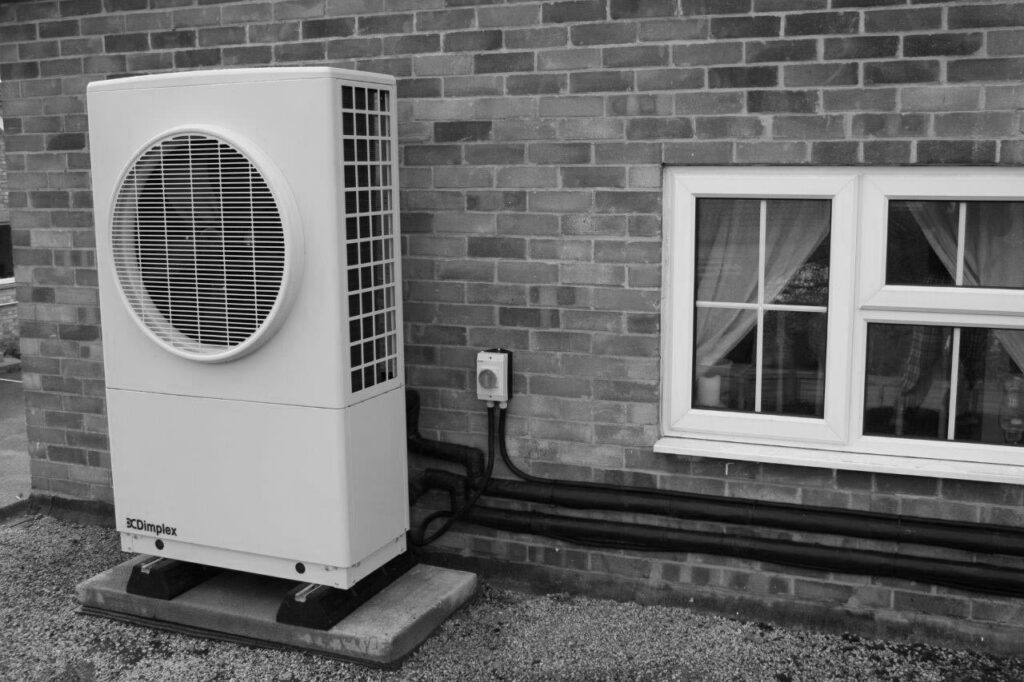
The fundamental change for the average person is likely to be the mass introduction of air-sourced heat pumps, many to be positioned in their back gardens, back yards, or on balconies in blocks of flats, to move away from gas boilers, and help meet the Government targets for achieving Net Zero. The current target is to prevent new gas boilers installed in new properties from 2025, and imposed limits in manufacturing them, circa 2035, but may be further amended.
Noise and Neighbouring Boundaries
Currently, there is specific guidance to installers to position electrically powered heat pumps a minimum distance away of one metre from a neighbouring properties’ boundary, to limit noise intrusion. However, that might change, and the prescribed distances reduced to allow more installations to reach the targets, with a potential resultant ambient noise increase noticed by residential occupants.
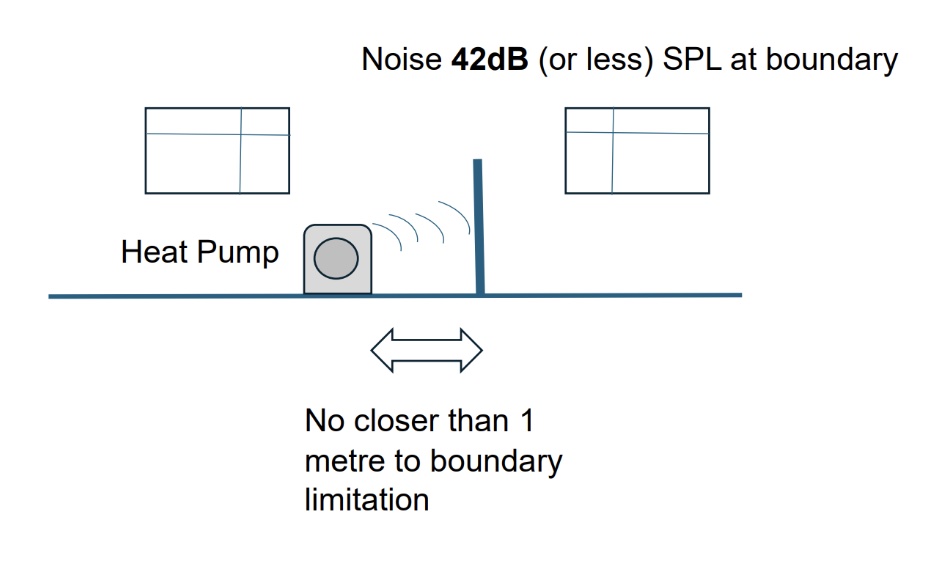
Boundary could be a fence or wall or building line, (or a balcony line or floor line to a block of flats)
Note that fixing a heat pump unit to a party wall could trigger The Party Wall etc Act 1996 or even become a legal trespass to a non-party wall if the adjoining owner has no consented to it.
Wales’s current permitted development rights (PDRs) to install an air source heat pump require a minimum three-metre distance from the neighbour’s boundary. The minimum distance in England and Scotland is a minimum distance of one metre to the boundary. These are in place to reduce potential noise pollution.
Sound Levels
Industry advice is that the noise from a heat pump should be no louder than 42 dBA at the boundary between properties. (About as loud as an average fridge). Under the Government Grant subsidy conditions for Boiler Upgrade Scheme installation, (MCS certification), it will have to be individually tested for sound pressure level.
EU Directive No 813/2013 outlined the maximum noise levels based on the time of day or night:
07:00 -19:00 Hours Maximum 45dBA at property Boundary
19:00 – 7:00 Hours Maximum 40dBA at property Boundary.
If you install a heat pump using a (BUS) Government Grant you have to adhere to the 42 dBA maximum SPL at the boundary, irrespective of the time of day. Note the property boundary could be vertical in flats, as well as horizontal. Also, at source, the heat pump output could be around 55 – 60dBA (weighted), at a one-metre distance from the unit.
Noise Impact on People
The sound level that could cause a neighbour concern and anxiety is subjective and may vary from person to person. The positioning of the unit and proximity to adjacent doors, windows, and boundaries, is, however, critical. Also, noise levels invariably increase if heat pump units are not properly maintained.
Review of the Regulations by Government
If the regulatory distances to the neighbouring boundary are relaxed, to meet Government climate-change targets, then we may be subjected to far higher noise intrusion from air-sourced heat pumps in our neighbourhoods. Note that Planning consent is generally under Permitted Development for HP units, with a few exceptions.
Legal situation
Environmental Health from the Council could get involved and it could become a law in Private Nuisance. Beware that if you take legal action against your neighbour for creating excessive noise, you might have to declare that fact under ‘Solicitors’ enquiries on behalf of Purchasers’ when you wish to sell your home. That might upset your intended purchaser. Note: If the neighbour’s heat pump installation falls within the regulatory guidelines, then you will probably be unsuccessful in obtaining an injunction to restrict noise further.
Impact on Industry
More trained installers are required, on an exponential scale.
This means there will invariably be some less competent installers who bypass some of the technical guidance and cut corners, installing cheaper, less reliable units, positioning them poorly, and probably resulting in higher noise levels in some cases.
Building Regulations
Building Regulations may get involved in such installations as they are electrically powered and may fall within Part P of the regulations and they are an energy device, and relevant to Part L of the regulations. There could even be Party Wall issues under The Party Wall etc Act 1996, in some installations.
Most will be self-certified under a ‘competent installer’ scheme, due to an insufficient amount of Building Inspectors, which is formally notified to the Building Control Authority following installation.
Working from Home and Impact
If you work from home, which has become more common, you require reasonably low background noise so that you can work efficiently, have online computer sessions, etc. If the heat pump from next door, or even your installation is noisy, that may impact your level of work output and efficiency. You may have to find another room to work in.
Putting a sound-reduction enclosure around the heat pump might be one answer, but it has to be generally open to work properly. It might also affect the warranty from the manufacturer and installer if partly enclosed.
What is the answer?
On one hand, we do need to move away from fossil fuels and gas boilers for the environment. On the other, we will have to find space outside our homes for air-sourced heat pumps and put up with some additional noise from them to varying degrees. Writing to your local MP with your concerns might be the first step. Technology may help to reduce noise levels over time.
There are several papers on the connection between noise and mental health. The problem is largely about Regulatory Controls by the State, and enforcement of them to avoid problems. Awareness of this needs to be raised. To highlight that some people will be affected by additional noise intrusion.
References:
Noise and Mental Health – (Various authors.)
Sound from domestic air source heat pumps-A Case Study Vol 42 Pt 1 2020 – M Torjessen. Institute of Acoustics paper.
Microsoft Word – SOUND FROM DOMESTIC AIR SOURCE HEAT PUMPS – A CASE STUDY.docx
Acoustic Noise Measurement of air-sourced heat pumps (EE0214) Building Performance Centre -September 2011 – (Scotland)