The Centre for Accessible Environments (CAE) carried out a qualitative review of nine Local Access Groups (LAG’s) across UK, this included interviews and desktop research and the main findings are summarised to share with members.
Background
The purpose of an access group is to reduce disabling barriers in the local built environment, through scrutineering and offering consumer-type advice to the public and authorities from lived experience and expertise. They were first established in the 1980’s, linked to the United Nations International Year of Disabled People in 1981.
Although there is no national data on how many groups there are, there has been a decline in the number of access groups, possibly linked to the role of an Access Officer in local authorities disappearing.
Scotland has an umbrella body, Disability Equality Scotland, funded by the Scottish Government providing LAG’s with training, governance, and critically a network on how to share best practice on improving the lives of disabled people at a local level. Disability Wales also supports LAGs in Wales, though their Access Officer role was made redundant some years ago. There is no national body supporting LAG’s in England.
Themes emerging from review:
1. Aims and engagement model
The type of engagement that access groups adopt varies – some groups are consultative bodies advising their local authority on barriers caused by inaccessible buildings and facilities, some also influence local policy and campaign for positive change. They are often a ‘critical friend’ to the local authority.
LAG’s are mainly independent grassroots groups, autonomous, comprised and managed by unpaid volunteers and linked to their local authority with some campaigning for positive change for disabled people. Most exist as a consultative body – but many expressed a desire to move towards a co-design or co-production model (https://www.thinklocalactpersonal.org.uk/Browse/Co-production/ and https://info.copronet.wales/co-production-definition-and-principles/), which is based on “doing with” disabled people, rather than “doing for”.
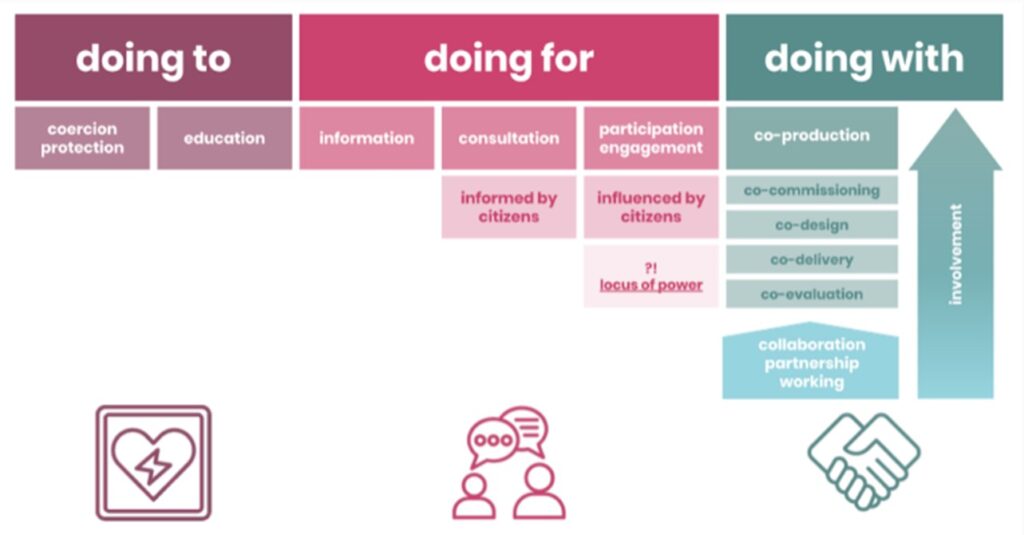
Figure: Co-production spectrumcredit: Coproduction Network for Wales (https://copronet.wales/)
2. Governance models
All the groups had a constitution or terms of reference. Some were written in technical language while others take a more inclusive approach, for example Hammersmith & Fulham (https://www.lbhf.gov.uk/councillors-and-democracy/co-production/co-production-implementation-group-hfcig) have developed their terms of reference to be succinct and written in plain English, with key terms explained, which may well encourage a wider range of residents to apply.
Both Hammersmith and Fulham, and Newham (https://www.newham.gov.uk/health-adult-social-care/co-production) have taken a strategic decision to adopt co-production as a core model. This shift from engagement and participation to co-production is supported by senior leadership – from the Council Leader and the Chief Executive – and championed at all levels to adopt the co-production model. The voice of disabled residents, carers, and community groups is valued and by facilitating meetings with a disabled resident and an elected member/councillor as co-chairs, decision-making is equally shared.
The pattern of meetings between the different groups varies, between half-day to full day each month, and many have adopted virtual or hybrid attendance. The positives of this new approach have been described as making meetings more accessible, collaborative, iterative, and flexible.
3. Membership and Recruitment
LAG membership numbers varied with on average 15 members, all the groups interviewed recognised the need to increase the intersectionality and diversity of the membership. Some groups understood the need to target younger disabled people, people of colour, LGBTQ disabled people, people with learning difficulties and members who identified as neurodiverse. Some groups felt that they did not have the capacity to undertake a recruitment drive.
4. Renumeration: Funding and support
It is good practice to create budgets for LAG’s, this recognises and acknowledges the expertise, lived experience and professional value of member’s time.
Members levels of remuneration varied from typically none to £400/day to an average of £100/day with the Chair paid a higher rate. Income-generation is a key issue, particularly independent groups that are not tied to a local authority. Manchester Disabled Peoples Access group1 is a registered charity and generates income from providing commercial advice and has developed a training scheme for its members aligned to NRAC accreditation.
Many LAGs expressed concerns about their lack of capacity and difficulty with planning and doing administration for the group. A few had dedicated officer support for the functioning of the group. Budgets for LAG’s should include:
- Renumeration for members and Chair
- Department level budgets
- Training and development for members and staff
- Officer time to support admin and meetings.
- Recruitment and induction for members
- Budget for reasonable adjustments
Having this support enables members to have more time to focus on decision-making, productive discussions and problem-solving.
5. The Role of Leadership
LAG’s within local authorities need to be embedded and supported by strong leadership and resources. Many of the groups we spoke to want more support and a wider remit, for example reviewing open spaces, equality strategies as well as transport and planning applications.
The support of Disability Equality Scotland (DES) is invaluable for the 35 panels across Scotland. They support best practice at a local and national level to keep accessibility at the top of the agenda and represent the views of disabled people, for example DES facilitates panel involvement with national policies such as recent Transport Scotland strategy.
Conclusion – Towards co-production
Co-production needs time, investment and resources and a true valuing of disabled people’s lived experience and expertise. It also needs strong leadership from “above and below” – and the recognition that power-sharing is important.
If LAG’s are set up in a resourced, participative, and developed in an inclusive way, co-production can produce highly effective outcomes and can have a positive impact on service provision and design and produce innovative solutions to problems. In co- production people providing and people receiving share power and responsibility, and work together in equal, reciprocal way. This needs to be championed and embedded across the organisation.

Given that there is no national body for Local Access Groups in England, and many of the groups we spoke to requested this, to have support in networking and sharing good co-production practice. The Access Association, perhaps in collaboration with Disability Rights UK, might be a good starting point.