A Musical introduction
Purchasing a new Stage Piano keyboard the other day, I never realised I would be entering the world of Haptic technology. This particular musical instrument has an organ, a digital one, like a ‘Hammond’, and uses physical knob sliders, called tonewheel drawbars.
Vision-impairment
Moving the nine sliding knobs around one can produce a vast range of sounds, (many millions of permutations), to simulate both Hammond and other tonewheel organs. It was of interest to me when I noticed a comment by a blind person against a Youtube demonstration of the instrument, when he stated “Being blind, there are lots of physical controls on this Stage Piano, and perfect for me to operate”.
This Yamaha digital keyboard does indeed incorporate numerous buttons, knobs, and controls on the top of it.
On many competitor’s products they usually would not exist to that same degree, many controls buried in multiple screen-menus, quite difficult to access, and even impossible for many vision-impaired people.
LED lights
There are also LED lights which can be set up in different colours to show the pre-set drawbar positions. The musician can even change the colours, (red, blue, green, turquoise, yellow, white, purple, etc).
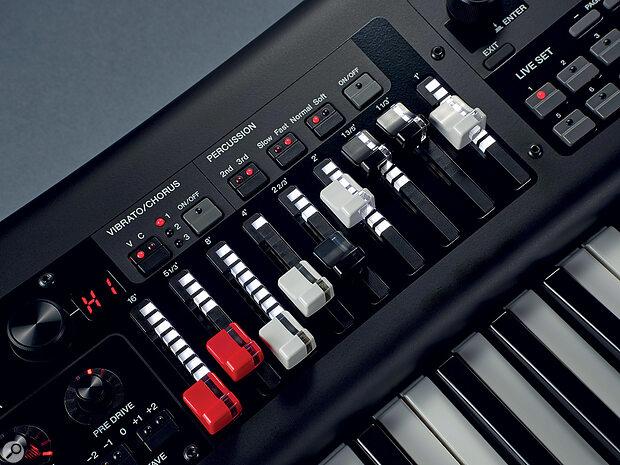
Many musicians fold their fingers over to grab the drawbar knobs, but it is appreciated not everyone will have the dexterity to do that easily. But you can just push each individual knob, up and down.
Another manufacturer, (Italian firm Dexibell), has a keyboard which has motorised drawbars which move automatically in an instant, so a vision-impaired person would be able to sense and feel the position of the organ ‘sound’, just by touching the knob sliders, if they pressed a pre-set button. They were not designed specifically for vision-impaired people, but the design has clear benefits for them, as well as sighted musicians.
Haptic Technology
So, what on earth is Haptic technology? It’s about 3-D touch, and the sense of touch and tactile experience. Part of kinaesthetic communication, where forces, vibrations, or motions are conveyed to the user by feeling and touch.
Human experiments
One experiment had a series of rods which pressed against a person’s back and with practice they could recognise shapes, objects without looking at them. Now your smartphone may advise you when a message is coming in, and the touchscreen may be interactive with the user.
It is recognised there are three key sensory systems in humans:
Cutaneous Kinaesthetic Haptic
It’s the Haptic one that uses active touch to communicate or recognize objects.
Tactile Categories
They fall into one of three categories for humans:
Graspable, Wearable and Touchable
Video games manufacturers are investing heavily in some of the devices to improve gaming experiences. The Apple™ company apparently has patents on some of the Haptic technology. It is changing our lives, and not just on Smartphones. The benefits for vision-impaired people and others, such as people with learning difficulties, could be significant as this technology moves forward.
The footbrake on my Hybrid car vibrates as the wheels slip on icy or very wet roads as the anti-lock brakes come into play, avoiding an accident. It’s communicating to me that something is not right out there on the road surface. Pilots have anti-stall vibrators through the control stick, communicating through their fingers and hands, as standard.
Pressure, friction, temperature can all be relevant for tactile experiences, such as in a wearable glove, with sensors attached.
In low gravity situations it is difficult to convey weight and mass of an object to someone. But scientists have designed a system called ‘Grabity’, to use the illusion of weight and inertia through touch and vibration. That could also be useful for many, if it is further adapted.
Disability solutions
As access professionals, we need to look and see how some of this technology can be introduced to aid disabled people in their day-to-day lives. There needs to be demand, in order to scale up the solutions, but unless the developers know there is a market out there to be satisfied, manufacturers may not invest in products. A bit ‘chicken and egg’ like.
A wood or plastic white cane is still Haptic technology for a blind person, but is very basic, and some vision-impaired people will want a better solution. That might use new technology, perhaps involving vibration through the hand and fingers, temperature or pressure-sensors on part of the body to indicate nearby objects. Or a combination of tactile communication and audio.
Remote working
Surgeons are performing complex operations many miles away from where they are based, using remote Haptic technology. They have to be able to sense or feel some aspects of the process to avoid injury or damage to the patient. The robotic arms are improving all the time.
As the sensors attached to the robots improve further, that technology will trickle down to others, and may help an older or a disabled person to grip a spoon or cup better. To live more independently, and not rely on others to the same degree as before.
Sources:
Yamaha UK YC61
Dexibell J7
Dexibell J7 Combo Keyboard Review UK – YouTube (2.13 minutes in)
https://www.smithsonianmag.com/innovation/heres-what-future-haptic-technology-looks-or-rather-feels-180971097/